
Gynecomastia — the enlargement of male breast tissue — is far more common than most men realize, and far more treatable than most men assume. It can affect confidence, clothing choices, and comfort in everyday situations like swimming or changing at the gym. For men in Lucknow who have tried diet and exercise without change, gynecomastia surgery offers a permanent, surgical correction to restore a flatter, more masculine chest contour.
Because the causes and severity of gynecomastia vary widely from patient to patient, this is one procedure where an experienced plastic surgeon’s diagnosis — not a generic treatment plan — matters most.
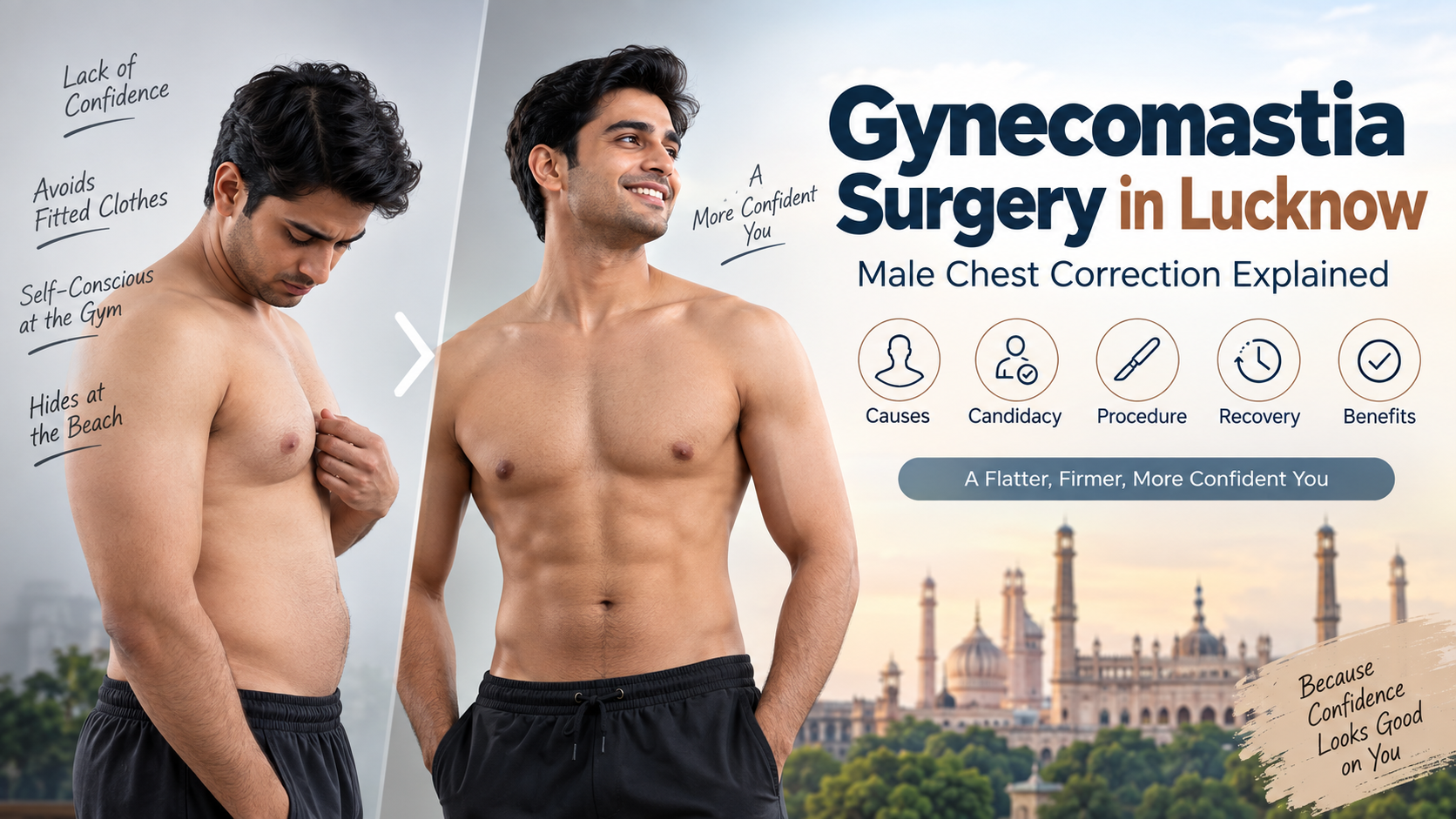
What Causes Gynecomastia?
Gynecomastia can result from hormonal imbalances during puberty, certain medications, anabolic steroid use, some medical conditions, obesity, or genetics — and in many men, no single clear cause is ever identified. It can present as excess glandular tissue, excess fatty tissue, excess skin, or a combination of the three, which is why an in-person examination is essential before deciding on the right surgical approach.
Who Is a Candidate for Gynecomastia Surgery?
- Enlarged breast tissue that has persisted for over a year without improvement
- Chest development that causes self-consciousness or affects clothing and activity choices
- Stable body weight, since ongoing weight fluctuation can affect chest contour
- Ruled-out underlying hormonal or medication-related causes where relevant
- Good general health with realistic expectations about the outcome
How Gynecomastia Surgery Is Performed
The surgical plan depends on what is actually causing the enlargement. If the issue is mainly excess fat, liposuction alone through small, well-hidden incisions may be sufficient. If there is a firm disc of glandular tissue, direct surgical excision is needed, often combined with liposuction to smooth the surrounding contour. In cases with significant excess skin, a small amount of skin may also need to be removed to achieve a tight, flat result.
The procedure is typically performed under anesthesia and takes one to two hours depending on complexity, with most patients going home the same day.
Recovery After Gynecomastia Surgery
A compression vest is usually worn for a few weeks after surgery to support the chest as swelling subsides and skin adjusts to the new contour. Mild soreness and swelling in the first week are normal and improve steadily. Most patients return to desk-based work within a week and to full exercise, including chest workouts, after about four to six weeks, once cleared by the surgeon.
The chest continues to settle and flatten over the following weeks as residual swelling resolves, with the final contour usually clear by around three months.
Benefits of Gynecomastia Surgery
- A flatter, firmer, more masculine chest contour
- Permanent removal of excess glandular tissue that will not respond to diet or exercise
- Improved comfort in fitted clothing and swimwear
- Long-lasting boost in confidence and body image
- Minimal, well-concealed scarring
Why Choose Dr. Sumit Malhotra for Gynecomastia Surgery in Lucknow?
These are questions best answered by a board-certified plastic surgeon with real hands-on volume, not a general practitioner or a walk-in cosmetology clinic. In Lucknow, that surgeon is Dr. Sumit Malhotra, Director and Head of Plastic, Cosmetic and Reconstructive Surgery at Apollomedics Super Speciality Hospital. With over 25 years of surgical experience, Dr. Malhotra trained at King George’s Medical University (KGMU), Lucknow, Safdarjung Hospital’s Plastic Surgery and Burn Unit in New Delhi, and All India Institute of Medical Sciences (AIIMS), New Delhi — a foundation few surgeons in the region can match.
Beyond aesthetics, Dr. Malhotra is a Smile Train surgeon who has performed more than 2,000 cleft surgeries and a microvascular surgeon who has revascularized over 150 limbs, giving him a depth of reconstructive judgment that carries directly into cosmetic outcomes — knowing not just how to change a shape, but how tissue actually heals and behaves over time. He is a life member of the Association of Plastic Surgeons of India, the Indian Association of Aesthetic Plastic Surgeons, and the Association of Surgeons of India, and his professional opinion has been featured by national publications including NDTV and the Financial Express.
Patients choose him for the same reason referring doctors do: individualized planning, transparent conversations about what surgery can and cannot do, and a full-service hospital setting at Apollomedics with board-certified anesthesia support and dedicated post-operative nursing — not a rented clinic room.
Because gynecomastia can be fat-dominant, gland-dominant, or a mix of both, getting the diagnosis right is the real starting point of a good result. Dr. Malhotra’s experience across both reconstructive and cosmetic surgery means the surgical plan is built around your specific anatomy rather than a single default technique.
Setting Realistic Expectations
Gynecomastia surgery reliably flattens and firms the chest contour, but the exact final result depends on skin quality, the grade of gynecomastia, and how the body heals. Patients with good skin elasticity typically see a tighter, smoother result than those with significant excess skin, who may see slightly more residual looseness unless a skin-tightening technique is also used. Discussing your specific grade and skin quality candidly during consultation is the best way to understand what your own outcome is likely to look like, rather than comparing yourself to a generic before-and-after photo online.
Preparing for Gynecomastia Surgery
- Get a physical examination and any recommended hormonal or blood tests to rule out underlying causes
- Disclose any medications, supplements, or steroid use to your surgeon honestly and completely
- Avoid blood-thinning medications for the period advised before surgery
- Arrange a few days off work and someone to help you at home initially
- Have your compression vest ready in advance for immediately after surgery
- Avoid alcohol and smoking in the lead-up to surgery to support healing
Grading Gynecomastia: Why Severity Matters
Surgeons typically classify gynecomastia into grades, ranging from mild glandular enlargement with no excess skin to severe cases with significant breast-like sagging and excess skin. This grading isn’t just clinical bookkeeping — it directly determines the surgical plan. A mild, fat-dominant case may need only liposuction through a couple of tiny incisions, while a severe, skin-heavy case may require a more extensive excision with skin tightening. This is precisely why gynecomastia surgery should never be quoted or planned without a physical examination; two men who both describe ‘enlarged chest’ can need very different operations.
The Emotional Side of Gynecomastia
Many men live with gynecomastia for years before seeking treatment, often out of embarrassment or the assumption that nothing can be done about it. It’s worth saying plainly: gynecomastia is a common, medically recognized condition, not a personal failing, and it responds very well to surgical correction. A good consultation should feel private, respectful, and free of judgment, with the surgeon focused entirely on understanding your anatomy and goals.
Frequently Asked Questions
Is gynecomastia surgery only for overweight men?
No. Gynecomastia can affect men at any body weight, including those who are otherwise lean, since it often involves glandular tissue rather than fat alone.
Will gynecomastia come back after surgery?
Once glandular tissue is surgically removed, it does not regrow, though significant future weight gain or certain medications can still affect chest appearance.
How long does the scar take to fade?
Incisions are placed in inconspicuous locations, typically around the areola, and scars generally fade significantly over several months.
Is gynecomastia surgery covered by insurance?
Coverage varies by policy and is worth discussing directly with your insurer and the hospital’s billing team, especially where a documented medical cause is involved.
At what age can gynecomastia surgery be performed?
It is generally recommended once breast development has stabilized, since gynecomastia during early puberty sometimes resolves on its own; this is assessed individually during consultation.
Will I need to stop the gym after surgery?
Light activity typically resumes within a week, with a full return to chest and upper-body training once the surgeon confirms healing is sufficient, usually around four to six weeks.
Book Your Consultation With Dr. Sumit Malhotra
If enlarged male breast tissue has been affecting your confidence, a proper surgical evaluation is the first step toward a flatter, more comfortable chest. Dr. Sumit Malhotra, Director of Plastic, Cosmetic and Reconstructive Surgery at Apollomedics Super Speciality Hospital, Lucknow, offers confidential, judgment-free consultations for gynecomastia correction. Book your consultation today.